Search This Blog

Tuesday, 24 February 2015

My first knitting competition

It's not like I would be dying of boredom here  but I decided to take up another challenge: I registered for my first knitting competition! I want to add here that I'm not exactly the most competitive type of person but the prospect of winning a 300 € voucher to spend on organic, hand-dyed and locally produced yarn was just too tempting. But now you might be wondering: how can you compete in knitting??

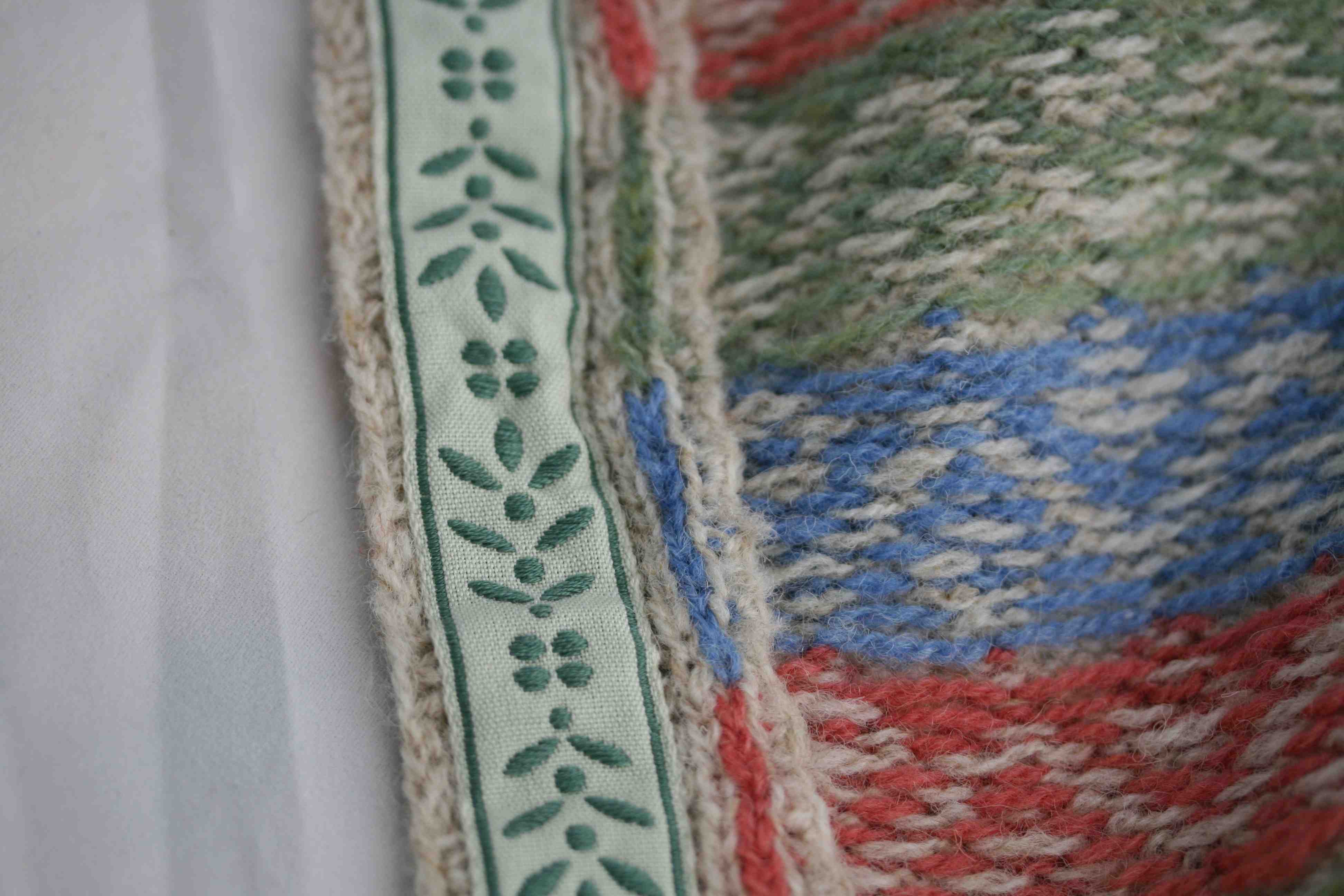
Well it's not about speed knitting for sure because I would totally suck. The competition is organized by an association that promotes wool production and sales in Wallonia, the southern region of Belgium and they are looking for a more artistic approach to raise awareness of how wool can be used creatively. When you register for the competition they send you 100 g of yarn (there is a fee of 10 € to participate but I figured that paying the money is worth it even if I just get to keep the yarn which is already value for money) and you have to make something out of it. The only condition is that you cannot use any other type of yarn or additional material. You are allowed to dye it and you can knit, felt, crochet or whatever you like.

I haven't decided what to make yet but I ordered the white yarn so that I can maybe get started on some experiments with natural dye. I read an article about berry-dyes or maybe avocado dye which sounded fun so I might try that out.

 If you're interested in the competition you can check out the terms and conditions here.


The raw material is pictured above. What will it be?!

Thursday, 19 February 2015

New space, new luck!

I've been complaining for some time that I don't have a proper crafting space in my flat which is mainly my own fault - I didn't plan on having one when I moved in. I also complained a lot about my sofa which is as uncomfortable as it is useful, or maybe I should say it WAS. Because I got finally rid of it! 

Now I have a new, more comfortable and pretty sofa (ok, it's brown but at least it has less stains than the old one) as well as a new crafting space. It has a proper table where I can leave my sewing machine out permanently as well as all my material close at hand (except my yarn stash which I couldn't fit anywhere in one space so far). I'm very glad that I don't have to dig out the sewing machine from its original box anymore, covered under a blanket and serving as a mirror-stand in my hallway, which was always a bit of a hassle. I hope that the easy availability will also motivate me to sew more often and more spontaneously.Oh dear, while I'm writing this I can already see how this will go.

The map under the table is still supposed to go up on the wall but I still have an aversion to putting nails in the wall so I'm trying to find another solution, maybe attaching it to the lamp? I also want to frame the old map of Belgium, I think it deserves better than some blue tack.


I'm very proud of my beautiful and ever-growing collection of cushions. The yellow wax print (see details above) was actually a gift from my friend Juliane who made it herself from the fabric that I had given to her before - isn't it gorgeous?! The black and white cover is made be me in one of my early sewing attempts; the cross-stitch cover is from my trip to Palestine in 2013 and the stripey-red one is, boringly enough, from IKEA. Ah well, not everything can be hand made.

Saturday, 14 February 2015

Be my Valentine

I don't care about Valentine's Day of course, even me who has a little romantic streak has realized that it's a way to sell more flowers, chocolate and expensive dinners. But coincidentally I just finished this lovely red cowl yesterday and I thought it fitted the theme quite well so I called it the "Be my Valentine" cowl, mainly because of the colour. 

This was just one of those "I need to do something inbetween bigger projects because otherwise I feel like I never finish anything"-projects and I'm officially still working on my "Marius" jumper. It turns out to be a bit trickier than expected because the pattern is, even with all my imagination, very cryptic and lacks a lot of information. 

One of the problems was for example that the pattern didn't state where to do the increases for the sleeves. It's difficult to integrate them into the pattern without messing it up but I suppose I just have to improvise again. I also had to read up on how to avoid the annoying "jump" in the pattern where the rounds join. I found some good ideas but it sucks that you always have the jog which makes the pattern look wonky.

I'm getting there though, the bodice and one sleeve are already finished so I'll post some more pictures here soon. Have a lovely Valentine's Day or rather, as the Finnish call it, ystävänpäivä (Friendship Day), doing lovely things with your lovely friends!


Pattern: Chunky brioche stitch cowl by Diana Levine
Yarn: Katia Merino Grosso, colour 12


Monday, 2 February 2015

From the sewing archives

I think I mentioned before that I'm more of a summer-sewing and winter-knitting person, although this will hopefully change soon with my new craft corner including a proper table to work with and additional lighting (currently the biggest limitation to my sewing activities). Anyway, I still have a few projects that I wanted to post but never found the time to do it, especially because summer = time to be outside and enjoy the sunshine and not sit at home and write a blog!

The patterns I used for the projects pictures below were very simple and basically all variations of either the tunic from the Marimekko "Surrur" book or from "Tuniques pour petits et grands" which I bought in FNAC a while ago.The fabrics were bits and pieces that I bought at the flea market (the dark green one with the polka dots), IKEA (the white one with the abstract floral pattern) and the Marimekko outlet shop in Helsinki (the blue one with the raindrops).

Everything is super easy to sew and perfect for a beginner like me. The simple cuts bring out the fabric's colours and patterns nicely - as you may have noticed I LOVE colours! And since I know that you like looking at silly pictures of me I have included an extra-silly one in the end, just in case you get bored.


Tunic with short sleeves in IKEA fabric, white with colourful pattern
 Pattern: Tunic from the Marimekko "Surrur"book
Fabric: IKEA

Tunic from the book "Tuniques pour petits et grands" in the Marimekko patterned fabric, blue with colourful raindrops
Pattern:  From the book "Tuniques pour petits et grands"
Fabric: Marimekko

Dress with peter pan collar and fabric from the flea market, green with light green polka dots

Dress with peter pan collar and fabric from the flea market, green with light green polka dotsDress with peter pan collar and fabric from the flea market, green with light green polka dots

Pattern: From the Marimekko "Surrur"book (+ added Peter Pan collar)
Fabric: Flea market


Wednesday, 21 January 2015

Eeek, a steek!

*This post is going to be a bit more technical so for everyone who is more into the pretty pictures please skip to the end of the post.*  Anyways, for everyone who will not be bored to death by the topic it could actually be quite useful because I had to do a bit of research (and practice) on it myself. 

First of all, steeking isn't as scary and difficult as it may sound, it's simply the process of cutting your precious knitting that you have worked on for weeks or months open with scissors to insert the sleeves or button band. I have definitely discovered its value especially for Icelandic and fair-isle patterns because you can just knit the whole garment in rounds: one big tube for the bodice and  two smaller tubes for the sleeves. That means you only knit and almost no purl is involved which makes working with different colours easier and makes your stockinette stitch look more regular (and it goes faster!).

I started off with one of my Icelandic cardigans, the "Aftur" pattern, as it was originally designed as a jumper but I preferred an open cardigan. I decided to put three extra purl stitches at the centre of the garment when knitting the "bodice tube" so that I would know where to cut later and this definitely helps. You don't have to put three stitches, one can also be enough but it might make you feel safer if you use the method for the first time. As the Icelandic yarn (Létt lopi in my case) is "sticky" enough a crocheted steek would theoretically work fine (see a useful youtube tutorial here). This technique is also used for fair-isle steeks because the wool yarn has the tendency to fray less because it is less slippery than for example merino, cotton or silk yarns. However, I chose to reinforce the steek with a sewing machine seam anyways because I was too scared to mess up my cardigan and I wanted to be on the safe side. 

Once you have secured the steek with a seam at both sides, either crocheted or with a sewing machine, you just cut it open. The ends will still fray a bit but you can pick out the loose ends and clean it up a little. I also chose to give the open seams a bit of a tidier look by crocheting over the seam. Alternatively you can sew a ribbon over it as a type of bias facing it is done sometimes in Norwegian or fair-isle cardigans. Kate Davies has for example done this on her "Ursula" cardigan. This might be difficult for Icelandic cardigans because the yarn is considerably thicker and it would make for a very bulky seam so I'm not sure if it is recommended. I like it because it looks very neat and tidy.

I found a very useful post on Norwegian steeks, which are a bit different, on Eunny Jang's blog which explains it quite well. In contrast to the Icelandic/ fair-isle steek mentioned above it has to be done with the sewing machine; a crocheted steek will probably not be enough to reinforce the garment edge. I came across this post because I want to start a Norwegian jumper soon but the original pattern I found didn't explain the steeking very well (how, when and where??). Knitty is also a good source of information on this topic. Another difference is that the Norwegian technique is used not only for cardigans but also for the sleeves and the neck which is new to me. I will put this technique to a test soon so keep your eyes open on this blog. It seems interesting because it also uses a steek for the sleeves and does not insert the sleeves by picking up stitches as you do with yoked sweaters but the sleeves are just sewn in onto the bodice, giving them more of a hanging style (I forgot what the exact word was to describe it but the shape comes out a bit more boxy than in a yoked sweater knitted in the round).

For anyone who is still hesitating I can only recommend to try it. Maybe don't start with that fair-isle jumper that you've been working on for a year but do a smaller test knit to see how it feels like. You will skip the annoying blocking of all the different pieces as well as the stitching up of the seams which I always hate. Plus, you can knit the garment as a jumper if you're not sure what it will look like and still steek it open afterwards (provided you didn't include the three purl stitches at the front, otherwise it'll look like a weird straight line on your jumper if you decide not to steek). In short, a perfect method for people like me who have difficulties making decisions!

 
Jumper knitted in the round with purl stitches to mark steek
Time to cut! Here you can see that the steek has been secured with a sewing machine seam on both sides.
With the button band attached.

Et voilà, the cardi is complete.

Thursday, 15 January 2015

Happy 2015!

Traveling over Christmas and New Year's also means that I missed those lazy days to work on a little knitting-retroperspective of 2014, something which I think is quite nice to sum up all the work that has been done. I'm proud to say that I only have one UFO ("Unfinished Object" in the unofficial knitting lingo) and that was my attempt to fix my lovely Estonian mittens. It's just a bit boring to knit the lining so we'll see if I will pick it up again before the winter is over or if I will give them up and just knit new ones.

The FOs (see abbreviation above) are definitely in the majority and I'm very happy to have accumulated this nice collection! I can definitely see a tendency towards the traditional Lopapeysa so my new year's resolution is to try something new, a real fair-isle jumper is already on my list and so is a Norwegian Setsedals jumper. 

My stash has also grown considerably and while I already have ideas for a few projects there is still a lot of this red-shaded yarn from Latvia. I also have three skeins in different shades of blue so I'm thinking about stocking up on some more contrasting colours when I'm going to Riga next month to get material for my fair-isle jumper. Apart from that I have enough for another Lopipeysa some red Merino yarn from unravelling an older project that I never wore, and, lo and behold, more Létt lopi (so maybe ignore what I wrote in the paragraph above, I think I'll have to give in to the temptation once more). 

Happy knitting in 2015 everyone!


Friday, 9 January 2015

Poland and Belarus

My love of traveling and of Eastern Europe in particular has caught up with me again! This time it was more of a coincidence though, we were looking for cheap tickets to go somewhere over New Year's and a certain low-cost airline had very cheap flights to Warsaw. Since I had heard mixed things about Warsaw I thought that a whole week there might be a bit long and after quickly checking the map I saw that Minsk wasn't too far away - et voilà!

The most difficult part of the whole trip was actually not the travel itself but getting the visa for Belarus. I only know one of my friends who had been there before and it was for work so she didn't have to go through all the hassle but it really seems like they want to keep tourists out on purpose. It was the most complex visa application I ever went through, even worse than for Russia! Not only did they require the usual papers, they also wanted an invitation letter from a Belarussian tourism agency, proof of payment for accommodation and a specific health insurance policy for the country (we later concluded it must be because of the icy pavements where we slipped more than once - breaking a leg doesn't seem like such a far-off option after that experience). After we had all the papers the visa was issued in a week so that was at least quite smooth.

We decided to take the train from Warsaw to Minsk because my experience with the old-fashioned sleeper trains had been excellent on my trips in Ukraine and Moldova. "Seat 61" provided the necessary details, as usual, and I checked all the timetables again on the Deutsche Bahn website which proved very accurate and reliable during our trip (you cannot buy international tickets online but it gives you an idea about the connections). On several online forums the Polrail website was recommended for buying tickets in advance and when I inquired for prices they had a very good service indeed. However, we decided against buying tickets in advance because officially you have to book a separate compartment if you're a couple as the compartments are usually gender specific and we wanted to stay flexible. That surprised me because it's the first time I heard that and of course the separate compartment was a lot more expensive. 

When we got to the station in Warsaw it was all totally easy and hassle-free though, we could book the cheaper tickets (ca. 65 € per person/one way) and the lady at the desk spoke very good English. I can really recommend doing the same thing as tickets hardly sell out and I did the same on my trip from Bucharest to Chisinau, too. The only disadvantage, as we later realized, is that the border control between Poland and Belarus is at about 2 am and the lady who was responsible for our compartment wouldn't let us convert our beds before that. This means that we actually only got to sleep around 3 am so paying for a sleeper train was basically pointless. On the way back we decided therefor to take a regular daytime train which only cost us about 25 € per person and was equally comfortable. The journey took about 10 hrs and we had to change twice but all the trains were on time and it went very smoothly so I can only recommend that - provided you like long train rides, that is. 

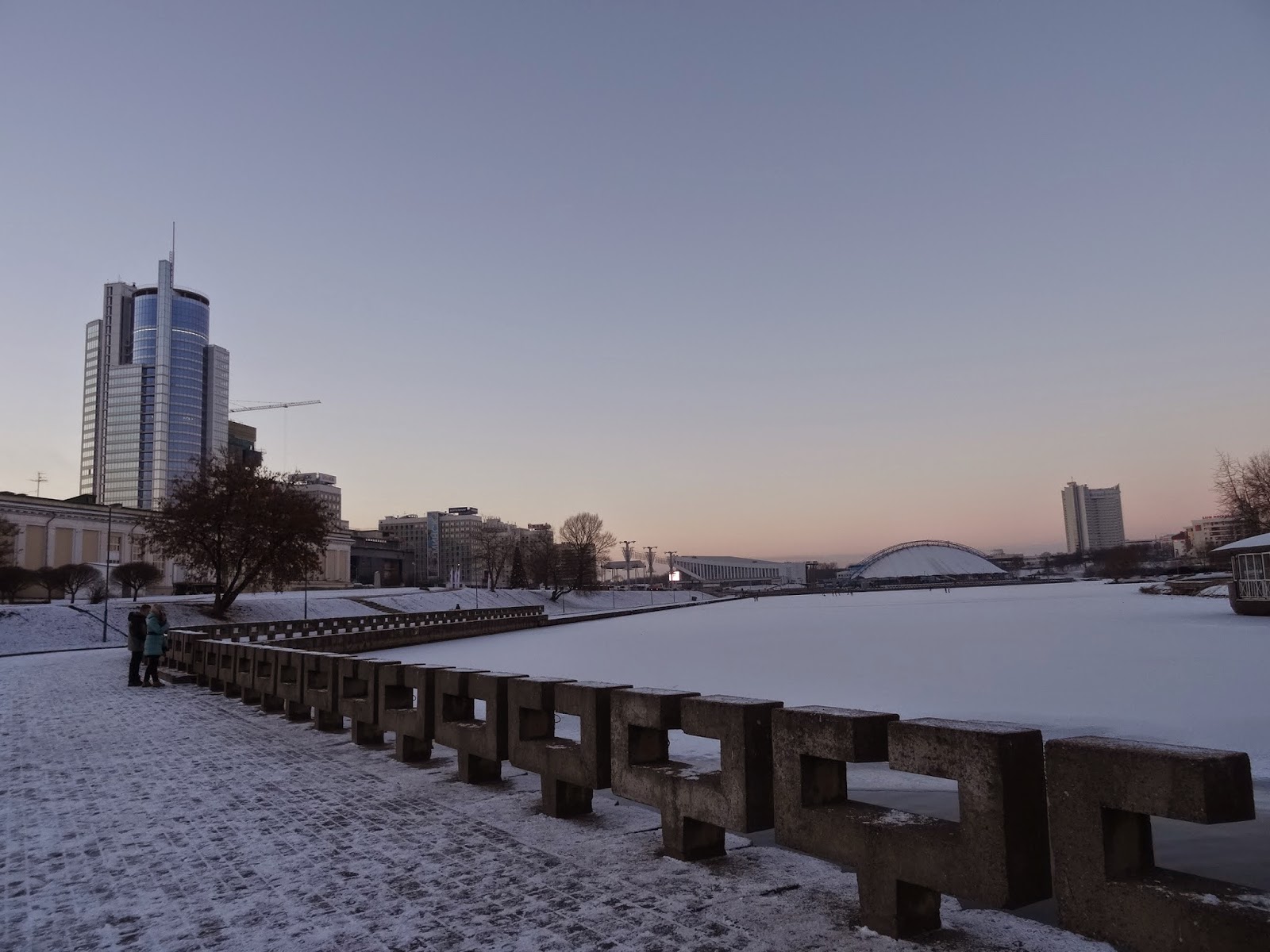
All the logistics aside, it was a fun trip! I was a bit disappointed of Warsaw which many people had praised before but to me it was just a bit too grey and too modern. I had expected a city comparable to Berlin 15 years ago but it was very different. I know that it was completely destroyed during the war and that everything had to be built from scratch but it still had this feeling of artificiality to it which for some reason Berlin doesn't have so much. Minsk on the contrary was still very much concrete and very much Soviet style but for some reason it worked better for me - maybe because I got what I expected. In general, Belarus seemed much wealthier than Ukraine and certainly Moldova so that was a surprise to me. We were only in the capital so who knows what the countryside looks like but all the train stations for example were super modern and, amazingly, very accessible for persons with disabilities! Also, people in Minsk generally spoke English and very friendly which was also a bit of a shock to me, expecting Ukrainian style blanking in the street and at sales counters. This happened only once in the theatre but after we checked online we saw that it was actually sold out so maybe the lady only wanted to spare herself the long explanation and just fended us off with  a simple but clear "niet". 

New Year's eve was an interesting experience. Again, I didn't have any expectations and I hadn't specifically come for wild parties and celebrations but when there weren't even fireworks I was a little disappointed I have to admit. We had also planned on going outside to have a glass (a.k.a plastic mug) of Belarussian "champagne" (there was exactly one brand of sparkling wine available in the supermarket, allegedly made in Belarus. It was contrasted with a range of at least 20 different types of vodka in the shelf next to it.) outside on the frozen river. But when we got there it was full of police, nicely spaced about every 20 metres along the river banks, probably to stop people from getting onto the ice. Well, you never know why else they were there. I hid the champagne bottle, too frightened to be arrested for drinking in public on my last day in Belarus. Instead we were invited by some Lithuanian students at the hostel to drink vodka with them which was an acceptable Plan B.

I can definitely recommend Minsk as a tourist, even in the winter. It was cold, around - 15 °C on our first day, but that didn't stop us from sightseeing and getting to places. There is a metro which covers most of the city and with the right clothes you can spend a day walking around with the occasional coffee break to warm up. Coffee shops are becoming more popular it seems but are fairly expensive compared to the normal restaurants and they don't have much food as we had to experience when we were hunting for a place to have breakfast and miserably failed (one of the lowest points of the trip for me at least). I wish we would have had more time to also visit the countryside but it'll have to be for next time. Maybe in a warmer season then.